Best Custom Sticker Material: A Practical Buyer’s Guide

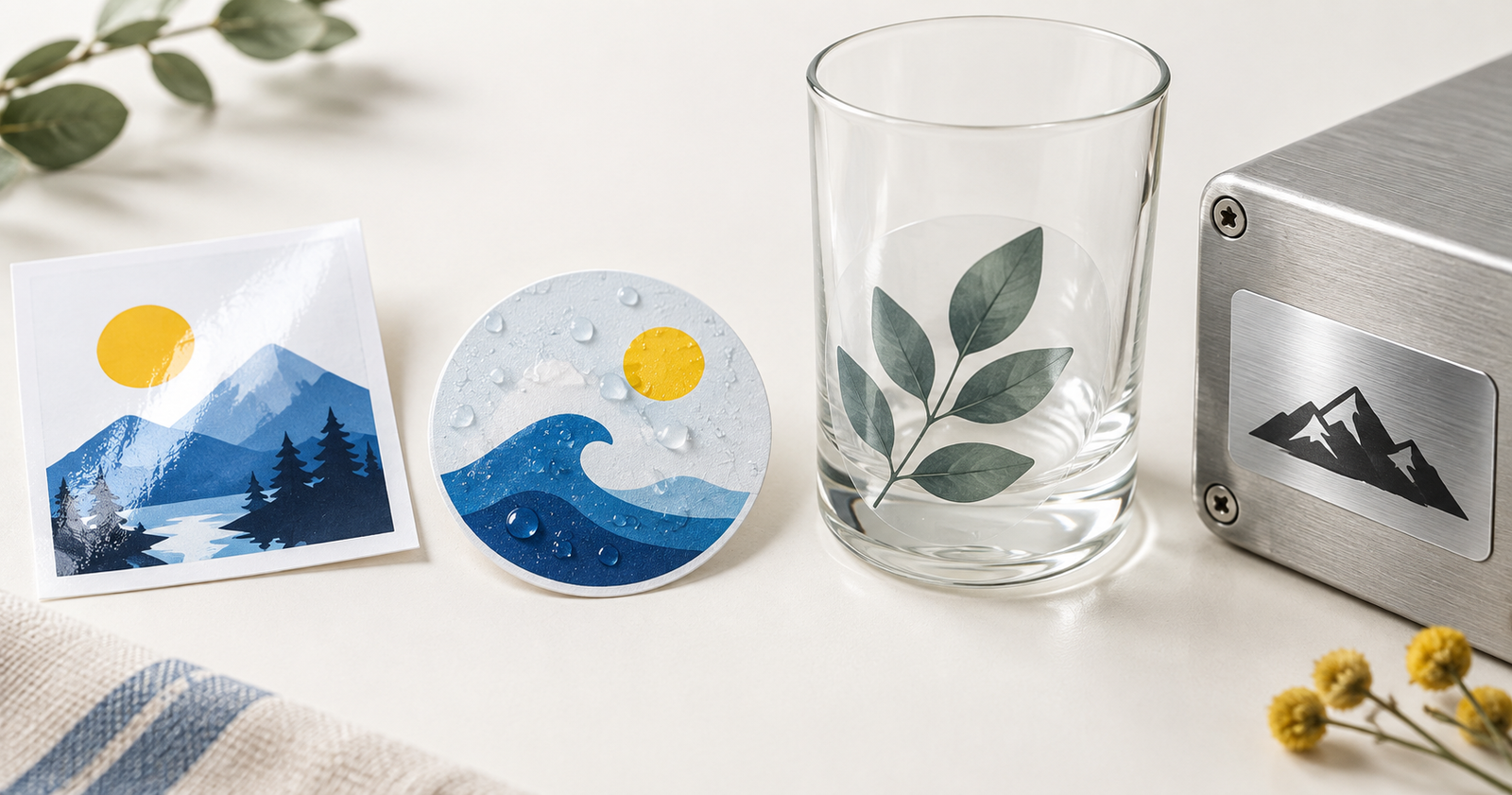
The best custom sticker material is the one that matches where the sticker will be applied, what it will encounter, and how you want it to look. A laminated paper sticker can be a practical choice for packaging and indoor promotions. Synthetic paper is better suited to moisture and frequent handling. Clear material creates a no-label appearance, while durable asset labels are designed for identification and equipment tracking.
Choosing by appearance alone can lead to peeling edges, muted colors, poor readability, or more durability than the job actually needs. This guide compares the four options available from YourWay Sticker so you can select a material with confidence before uploading your artwork.
Product specification note: The material principles below are general guidance. Confirm the exact face material, laminate, adhesive, ink, white-ink availability and tested exposure limits for your selected YourWay Sticker product before placing a bulk order.
Key Takeaways
- Choose laminated paper for cost-conscious indoor packaging, promotions, and short-to-medium-term applications.
- Choose synthetic paper when moisture, tearing, or frequent handling is a concern.
- Choose clear stickers when the surface should remain visible through the design; consider white ink for dark backgrounds.
- Choose durable asset labels for equipment identification, barcodes, QR codes, and long-term tracking.
- Test a sample on the actual surface and in the actual environment before placing a large order.
Quick Sticker Material Comparison
| Material | Construction | Best suited for | Main advantage | Check before ordering |
|---|---|---|---|---|
| Laminated paper | Printed paper face protected by a clear film | Boxes, bags, envelopes, gift packaging, indoor promotions | Familiar paper look with improved resistance to scuffs and splashes | Exposed edges, moisture level, expected service life |
| Synthetic paper | Polymer-based, paper-like substrate | Refrigerated packaging, frequently handled labels, damp environments | Greater resistance to water and tearing than ordinary paper | Exact substrate, ink, adhesive, and exposure conditions |
| Clear sticker | Transparent film with printed artwork | Glass, windows, bottles, transparent or light-colored packaging | Clean no-label appearance | Surface color, white-ink availability, bubbles and visibility |
| Durable asset label | Durable face material, adhesive, print and optional protective layer working as a system | Tools, machinery, electronics, property and equipment | Long-term identification and tracking | Surface texture, temperature, abrasion, chemicals and adhesive compatibility |
This table is a starting point, not a substitute for testing. Performance depends on the complete construction: face material, printing method, protective laminate, adhesive, application surface and environmental exposure.
Not sure which construction fits your application? Browse all sticker products and choose the best option for your surface and exposure conditions.
Shop Stickers by Material
Choose a sticker type to view product options, pricing, and customization details.
What Are Laminated Paper Stickers?
Laminated paper stickers use printed paper as the face material and add a transparent protective film over the print. The laminate helps protect the image against handling, scuffing, splashes and everyday wear while preserving the familiar appearance of a paper sticker.
Lamination does not turn the paper face into vinyl. The accurate description is “laminated paper sticker” or “paper sticker with a protective overlaminate.” The distinction matters because moisture can still reach exposed paper edges, and the finished sticker’s performance also depends on the adhesive, ink and application conditions.
Avery Dennison’s technical guidance on overlamination describes the laminate as a barrier that can improve resistance to abrasion, moisture, chemicals and ink fading. Those benefits do not make every laminated paper construction fully waterproof or suitable for dishwashers and permanent outdoor exposure.
Choose laminated paper for:
- Product boxes and dry indoor packaging
- Envelope seals and thank-you stickers
- Event giveaways and promotional stickers
- Gift wrapping and seasonal campaigns
- Short-to-medium-term branding where paper texture and price matter
Consider another material when:
- The sticker will stay wet or face condensation repeatedly
- It may be torn, scraped or handled throughout the day
- It must remain readable on equipment for an extended period
- A transparent background is part of the design
Paper vs Synthetic Stickers: Which Is Better?
Paper stickers are best for dry indoor packaging, promotional seals, gifts, and cost-sensitive projects. Synthetic paper stickers are the better choice when labels may face condensation, splashes, tearing, or frequent handling. Both can provide a paper-like printed appearance, but synthetic paper uses a polymer-based substrate and generally offers greater moisture and tear resistance.
Choose laminated paper for boxes, bags, envelopes, and short-to-medium-term indoor branding. Choose synthetic paper for refrigerated packaging, bottles, frequently handled labels, and damp environments. Neither material name guarantees performance in every application: adhesive, laminate, ink, surface preparation, and exposure conditions still matter. Test a sample on the actual surface before ordering a large quantity.
When Is Synthetic Paper the Better Choice?
Synthetic paper stickers are a better fit when you want a paper-like printable surface with more resistance to moisture and tearing. Synthetic paper is made from polymer-based material rather than conventional wood-pulp paper.
YUPO describes synthetic paper as a film-based material with paper-like characteristics, while PPG positions Teslin synthetic material for durable labels and tags that may encounter water, abrasion and demanding handling. Exact performance still varies by grade, printing process, adhesive and finish.
This makes synthetic paper useful for labels that may encounter refrigeration, condensation, damp hands or frequent handling. It can also be a sensible step up when ordinary paper is too vulnerable but an industrial asset label would be unnecessary.
Choose synthetic paper for:
- Bottles or containers exposed to occasional moisture
- Refrigerated packaging and areas where condensation may occur
- Labels handled repeatedly during fulfillment or use
- Outdoor or semi-outdoor applications after suitable product testing
- Projects that need a paper-like appearance with improved toughness
Do not rely on the word “synthetic” alone. Before ordering, confirm whether your application involves immersion, cleaning chemicals, strong sunlight, extreme temperatures or repeated abrasion. A sample test is more useful than a broad waterproof claim.
When Should You Use Clear Stickers?
Clear stickers are designed for projects where the underlying surface should remain part of the visual design. They are especially effective on glass, windows, transparent bottles and smooth packaging where a white sticker background would interrupt the look.
Clear material can create a premium no-label effect, but the application surface affects the final color. Standard colored inks may appear less opaque on transparent material, and dark or strongly colored backgrounds can reduce contrast. Avery’s guidance for clear labels recommends a white underprint when clear labels are used on dark surfaces.
Choose clear stickers for:
- Glass jars, bottles and windows
- Transparent or light-colored packaging
- Minimalist branding and no-label visual effects
- Designs that intentionally use the product color as part of the artwork
Prepare the artwork carefully:
- Identify which areas should be transparent.
- Preview the design against the actual surface color.
- Ask whether white ink or a white underbase is available.
- Keep fine text and important details away from low-contrast areas.
- Test one sample on the final container before approving a large run.
Clear does not describe a single universal material. Depending on the product specification, a clear sticker may use polyester, polypropylene, vinyl or another film. Ask about the exact construction if the application has demanding performance requirements.
What Makes a Durable Asset Label Different?
Durable asset labels are intended for identification rather than decoration alone. Common uses include property numbers, serial information, barcodes, QR codes, equipment identification and maintenance tracking.
An asset label is a system, not simply a thicker sticker. The face material, adhesive, ink, protective layer and target surface must work together. A label that bonds well to smooth stainless steel may behave differently on textured plastic, powder-coated metal or a slightly oily machine housing.
3M’s technical information for durable polyester label material highlights the importance of both the polyester face material and an adhesive designed for demanding surfaces. This is why an asset-label order should start with questions about the surface and exposure conditions, not only size and color.
Choose a durable asset label for:
- Tools, machinery and production equipment
- Computers, electronics and office property
- Barcode or QR-code tracking
- Serial, service and maintenance information
- Applications that require stronger resistance to abrasion or moisture
Do not assume a label has a specific certification simply because it is described as durable. UL’s Marking and Labeling Systems program evaluates the complete marking and labeling system, not a vague material category. Unless a product has documented certification for its exact construction and printing process, it should not be presented as certified or recognized.
How to Choose the Right Material in Five Steps
1. Start with the application surface
Determine whether the sticker will be applied to glass, paperboard, coated packaging, metal, smooth plastic, textured plastic or another material. Clean, smooth, dry surfaces are usually easier to label than dusty, oily, textured or low-surface-energy plastics.
2. List the real exposure conditions
Will the sticker encounter condensation, splashes, rain, sunlight, friction, cleaning products, refrigeration or temperature changes? Separate occasional exposure from continuous exposure. “May get splashed” is a different requirement from “will be submerged or washed repeatedly.”
3. Decide how long it needs to work
A promotional seal used for a weekend event has a different job from an equipment label expected to remain readable through years of handling. Avoid paying for industrial performance when the application is temporary, but do not select paper purely on price for a demanding environment.
4. Match the visual effect
Use laminated paper for a familiar printed-paper appearance, synthetic paper for a similar look with greater toughness, clear material for transparency, and durable asset labels when identification performance is the priority.
5. Order a proof and test a sample
Artwork proofing confirms shape, dimensions, spelling, cut lines and visual layout. A physical sample test answers different questions: Does the adhesive bond to the actual surface? Are the colors readable? Do the edges remain flat? Does the label tolerate the expected moisture and handling?
Whenever possible, test the sample under realistic conditions before ordering at scale.
Common Sticker Material Mistakes
Calling laminated paper “vinyl”
A protective film can improve the durability of a paper sticker, but the face material remains paper. Describe the complete construction accurately so customers can make an informed choice.
Treating “waterproof” as a universal property
Water resistance depends on more than the face material. Ink, laminate, adhesive and exposed edges all affect the finished result. State the intended conditions and test accordingly.
Ignoring the color beneath a clear sticker
Clear labels can look excellent on glass but lose contrast on dark packaging. Preview the design against the real background and consider a white underprint.
Choosing an asset label without checking the surface
Surface texture and surface energy have a major effect on adhesion. Provide details about the equipment material, finish and operating environment when requesting a durable label.
Skipping a real-world sample test
A digital proof validates artwork, not field performance. Apply a sample to the real surface and expose it to normal handling before committing to a high quantity.
Frequently Asked Questions
Does lamination make a paper sticker waterproof?
Lamination improves resistance to moisture, scuffing and handling by covering the printed face with a protective film. It does not automatically make the entire construction waterproof because paper may remain exposed at the edges, and the adhesive and ink also affect performance.
Is synthetic paper the same as regular paper?
No. Synthetic paper is a polymer-based material engineered to provide paper-like printing and handling properties with greater resistance to water and tearing than conventional paper. Exact characteristics depend on the selected grade.
Are clear stickers suitable for dark surfaces?
They can be, but ordinary colored ink may appear muted or difficult to read. A white underprint can improve opacity and contrast. Confirm white-ink support and test the design on the actual surface.
What information should I provide for an asset label order?
Provide the target surface, surface texture, indoor or outdoor use, expected moisture, abrasion, temperature, chemical exposure, label size, barcode or QR requirements and expected service period. These details help determine whether the complete label system is suitable.
Should I order a sample before buying in bulk?
Yes, especially for damp, outdoor, textured, curved or frequently cleaned surfaces. A sample test is the most reliable way to check adhesion, readability and durability in your actual application.
Choose the Material That Fits the Job
Sticker material selection becomes simpler when you focus on four questions: What is the surface? What will the sticker encounter? How long must it remain useful? What should it look like?
- Choose laminated paper for indoor packaging, promotions and everyday branding.
- Choose synthetic paper for greater resistance to moisture, tearing and handling.
- Choose clear stickers when transparency and a no-label appearance matter.
- Choose durable asset labels for equipment identification and tracking.
Ready to compare options with your own artwork? Shop custom stickers and choose the right product before production.
About the publisher: YourWay Sticker provides custom printed stickers and labels for packaging, branding, transparent applications and equipment identification. Product-specific performance claims should be supported by the applicable material specification and sample testing.
Editorial method: This guide separates the sticker face material from its laminate and adhesive, compares products by intended application, and relies on manufacturer technical guidance from Avery Dennison, YUPO, PPG and 3M. Recommendations are deliberately conditional where final performance depends on the exact product construction or application environment.
