Laminated Paper vs Vinyl Stickers: Key Differences

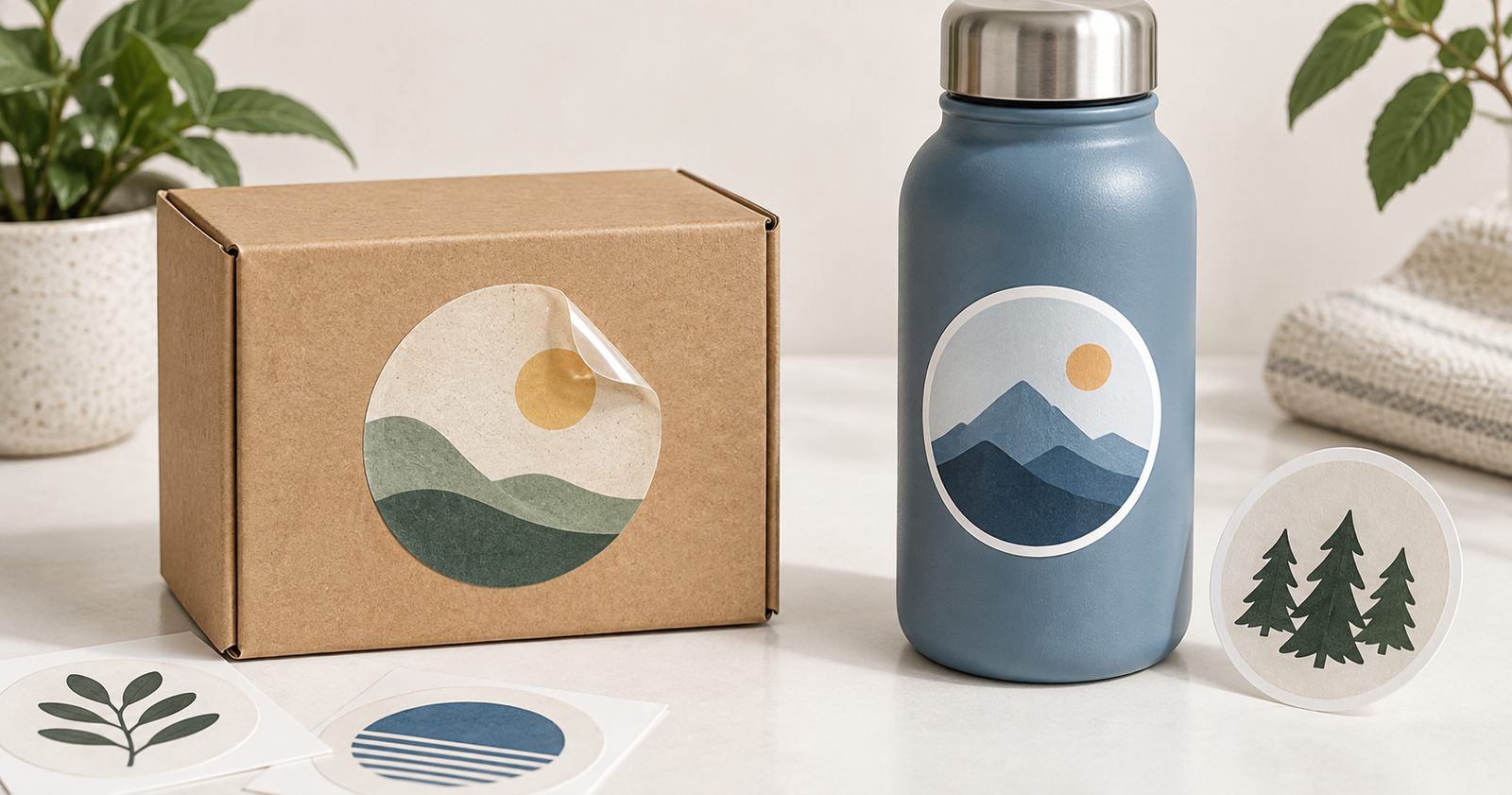
Laminated paper stickers and vinyl stickers can look similar after printing, but they are not the same construction. A laminated paper sticker has a paper face protected by a clear overlaminate. A vinyl sticker uses vinyl film as its face material. That difference affects how each sticker handles moisture, tearing, curves, outdoor exposure, and cost.
The better option depends on the job. Laminated paper is often the practical choice for dry indoor packaging, promotional labels, and short-to-medium-term branding. Vinyl is usually better when the sticker must tolerate repeated moisture, outdoor exposure, stretching, or a curved surface.
Key Takeaways
- Lamination protects a paper sticker, but it does not change the paper face into vinyl.
- Laminated paper is well suited to indoor packaging, boxes, bags, envelope seals, and cost-conscious promotions.
- Vinyl is generally more suitable for wet, outdoor, curved, or frequently handled applications.
- Water resistance depends on the complete construction: face material, ink, laminate, adhesive, exposed edges, and application surface.
- A physical sample test is the safest way to confirm adhesion and durability before a large order.
Laminated Paper vs Vinyl Stickers at a Glance
| Comparison | Laminated Paper Sticker | Vinyl Sticker |
|---|---|---|
| Face material | Paper | Vinyl film, commonly PVC in products described specifically as vinyl |
| Protective layer | Clear gloss or matte overlaminate | May be unlaminated or protected with an additional overlaminate |
| Best environment | Dry indoor and limited-moisture applications | Wet, outdoor, curved, and demanding applications, subject to product specifications |
| Tear resistance | Improved by the laminate, but exposed paper edges remain vulnerable | Generally more tear-resistant and flexible |
| Conformability | Best on smooth, relatively flat surfaces | Often better on curved or contoured surfaces |
| Appearance | Familiar printed-paper look with a protected finish | Smooth film appearance; available in white, clear, gloss, and matte constructions |
| Typical uses | Boxes, bags, envelopes, event stickers, indoor promotions | Bottles, outdoor branding, helmets, vehicles, equipment, and frequently handled items |
| Cost | Often the more economical option | Often costs more because of the film construction and performance requirements |
These are general material tendencies, not guarantees for every product. Adhesive type, print process, laminate, application temperature, surface texture, and exposure conditions can change the result. For a broader overview, see our custom sticker material buyer’s guide.
What Is a Laminated Paper Sticker?
A laminated paper sticker starts with paper as the printable face material. After printing, a clear film is applied over the printed surface. The overlaminate may add gloss or a matte effect while protecting the image from handling, scuffs, moisture, chemicals, and fading.
Avery Dennison’s pressure-sensitive overlamination guidance describes an overlaminate as a protective barrier applied to a label substrate. It can improve resistance to abrasion and high-moisture conditions, but the original substrate remains part of the finished construction.
That distinction is important. The clear protective layer covers the printed face, while the paper may still be exposed at cut edges. Water can reach those edges, and the adhesive may have different moisture limits from the laminate. For that reason, “laminated” should not automatically be interpreted as “fully waterproof.”
Our standard stickers are intended for buyers who want an economical printed sticker with a protective finish. Confirm the exact laminate, adhesive, and tested exposure conditions for your order when moisture or long service life matters.
What Is a Vinyl Sticker?
A vinyl sticker uses vinyl film as the face material rather than paper. The printed film is combined with an adhesive and release liner, and it may also receive a clear overlaminate when additional protection is required.
The face material is what makes it a vinyl sticker. For example, 3M’s technical data for a vinyl durable label material identifies soft white vinyl as the face material and lists the adhesive and liner as separate parts of the construction. This is different from placing a clear film over a paper face.
Vinyl is typically flexible and conformable, which can help it follow bottles, curved containers, helmets, or equipment surfaces. 3M describes its vinyl label constructions as suited to applications where conformability, moisture resistance, and longer service life are important. Exact performance still depends on the vinyl formulation, thickness, adhesive, ink, laminate, and installation.
If the job requires a film-like appearance but not specifically PVC vinyl, synthetic paper stickers may also be worth comparing. Synthetic paper uses a polymer-based substrate with paper-like printing characteristics and improved resistance to water and tearing.
Does Lamination Turn Paper into Vinyl?
No. Lamination adds a protective film over paper, but it does not replace the paper face material. The finished sticker is best described as a laminated paper sticker or a paper sticker with a protective overlaminate.
Think of the construction as layers:
- Printed paper face
- Clear protective overlaminate
- Pressure-sensitive adhesive
- Release liner
A vinyl sticker has a different first layer:
- Printed vinyl face
- Optional protective overlaminate
- Pressure-sensitive adhesive
- Release liner
Both products can have a glossy plastic-like surface. Both can resist occasional splashes. The visible finish alone does not identify the face material underneath.
Accurate terminology helps buyers choose the right product. Calling every laminated sticker “vinyl” can create the wrong expectation for outdoor life, edge exposure, tear resistance, or continuous water contact.
Which Sticker Handles Water Better?
Vinyl generally has the advantage when repeated moisture or outdoor exposure is expected because the face material itself is a film. Laminated paper can handle splashes and damp handling better than unprotected paper, but exposed edges remain a possible path for moisture.
HERMA recommends film labels instead of paper when labels face difficult conditions such as moisture, cold, heat, or dirt in its guidance on weather-resistant labels. This supports a practical decision rule: use laminated paper for limited exposure and choose a film construction when moisture is a regular part of the application.
Neither material should be described as dishwasher-safe, submersible, chemical-resistant, or suitable for permanent outdoor use without a product-specific test. Printing ink and adhesive can fail even when the face material remains intact.
Before ordering, define the real exposure:
- Occasional splash or damp hand
- Refrigeration and condensation
- Rain and sunlight
- Repeated washing
- Immersion
- Cleaning chemicals
- Abrasion against other objects
The more severe and frequent the exposure, the more important it is to confirm a tested film, ink, laminate, and adhesive combination.
Which Sticker Is More Durable?
Vinyl usually wins for tear resistance, flexibility, and demanding handling. Laminated paper gains useful surface protection from its overlaminate, but the paper core can still crease, absorb moisture at the edges, or tear once damaged.
The difference is most noticeable on curved and frequently handled objects. A flexible vinyl face can conform more naturally to a bottle or curved container, while paper prefers a smoother, flatter surface. Vinyl can also be the better starting point for outdoor graphics and equipment labels, provided the adhesive and printing system are designed for that environment.
For permanent identification, neither a general paper sticker nor a decorative vinyl sticker should automatically be treated as an industrial asset label. Our durable asset labels are designed around identification requirements such as barcodes, QR codes, serial information, equipment surfaces, and longer-term tracking.
Which Option Looks Better?
Neither material is universally more attractive; they create different visual effects.
Laminated paper preserves the familiar look of printed paper while adding a smooth gloss or matte protective finish. It works well for product boxes, bakery packaging, envelopes, gift bags, thank-you stickers, and promotional seals where paper packaging is already part of the design.
Vinyl usually has a smoother film appearance and can work well on bottles, windows, helmets, cases, and equipment. It is a strong choice when the sticker should look clean on a curved or non-paper surface.
When the surface itself should remain visible, consider clear stickers instead. Clear film can create a no-label effect on glass or transparent packaging, although white ink may be needed to maintain contrast on dark backgrounds.
Which Sticker Costs Less?
Laminated paper is often the more economical choice for indoor packaging and promotional work. Vinyl can justify a higher cost when its flexibility, moisture resistance, or service life prevents premature replacement.
The lowest unit price is not always the lowest total cost. A paper sticker used on a dry product box may perform perfectly and avoid unnecessary expense. The same construction used on a refrigerated bottle could develop edge problems and require reprinting. Conversely, specifying a heavy-duty vinyl construction for a one-day indoor event may add performance that the project never uses.
Compare quotes using the full specification rather than the material name alone:
- Face material
- Adhesive type
- Gloss or matte laminate
- Ink and printing method
- Shape and cut method
- Quantity
- Application surface
- Expected service period
- Environmental exposure
When Should You Choose Laminated Paper?
Choose laminated paper when the sticker will be used primarily indoors, applied to a clean and relatively flat surface, and exposed to limited moisture.
It is a practical option for:
- Product boxes and paperboard packaging
- Kraft bags and gift packaging
- Envelope seals and thank-you stickers
- Indoor event and promotional stickers
- Seasonal campaigns
- Short-to-medium-term branding
- Projects where cost and a printed-paper appearance matter
Laminated paper is not the best choice when the sticker will remain wet, sit outdoors for long periods, wrap around a tight curve, or experience repeated abrasion.
When Should You Choose Vinyl?
Choose vinyl when flexibility, repeated moisture exposure, outdoor use, or stronger tear resistance is more important than achieving a paper-like appearance.
Common applications include:
- Water bottles and drink containers
- Helmets and hard cases
- Windows and smooth outdoor surfaces
- Curved packaging
- Frequently handled promotional stickers
- Vehicle or equipment graphics made from an appropriate product-grade construction
- Applications requiring a longer service period
Do not assume that every vinyl product has the same outdoor rating. Vinyl face materials can use different plasticizers, thicknesses, adhesives, inks, and overlaminates. Ask for the exact specification when sunlight, temperature changes, chemicals, or long-term removability matter.
How to Choose in Five Steps
1. Identify the application surface
Write down whether the sticker will be applied to paperboard, glass, metal, smooth plastic, textured plastic, a coated bottle, or another surface. Adhesive performance changes with surface energy, texture, contamination, and curvature.
2. Define moisture and weather exposure
Separate occasional splashes from repeated condensation, washing, rain, or immersion. Use the most demanding realistic condition, not the best-case condition.
3. Set the required service life
A sticker for a weekend promotion has a different job from a bottle label used for months or an equipment label expected to remain readable for years.
4. Choose the visual effect
Select laminated paper for a protected paper appearance. Select vinyl for a flexible film appearance. Select clear material when transparency is part of the design.
5. Test a production sample
Apply the sample to the real surface and expose it to normal handling, moisture, refrigeration, sunlight, or cleaning. A digital proof checks artwork; a physical sample checks performance.
Common Buying Mistakes
Choosing by finish alone
A glossy surface does not prove that a sticker is vinyl. Gloss can come from a clear overlaminate placed over paper or film.
Treating water-resistant and waterproof as identical
Water resistance is conditional. Ask how long the sticker will be exposed, whether edges are exposed, and whether the adhesive and ink were tested for the same conditions.
Ignoring the adhesive
The best face material cannot compensate for an adhesive that is wrong for a textured, oily, cold, curved, or low-surface-energy surface.
Skipping a sample test
Material descriptions provide a starting point. A real-world test reveals adhesion, edge lift, color contrast, flexibility, and durability on the actual product.
Frequently Asked Questions
Are laminated paper stickers waterproof?
Lamination improves resistance to moisture and splashes by protecting the printed face. It does not automatically make the complete sticker waterproof because paper may remain exposed at the edges, and the ink and adhesive have their own limits.
Are vinyl stickers always suitable outdoors?
No. Vinyl is generally a better face material for outdoor applications, but outdoor performance depends on the exact vinyl, ink, adhesive, overlaminate, sunlight, temperature, and expected service period.
Can laminated paper stickers be used on bottles?
They can work on dry bottles or containers with limited moisture exposure. For refrigeration, condensation, washing, or repeated wet handling, a suitable synthetic or vinyl construction is usually the safer choice.
Is synthetic paper the same as vinyl?
No. Synthetic paper is a polymer-based material designed to offer paper-like printing and handling characteristics. Vinyl is a specific film category with its own flexibility and durability properties. Confirm the actual material specification rather than relying on the word “plastic.”
Should I order a sample before buying in bulk?
Yes, especially for curved, wet, cold, textured, outdoor, or frequently cleaned surfaces. A sample test is the most reliable way to confirm that the complete sticker construction matches the job.
The Final Verdict
| Decision Factor | Better Starting Point |
|---|---|
| Dry indoor packaging | Laminated paper |
| Cost-conscious promotions | Laminated paper |
| Familiar paper appearance | Laminated paper |
| Repeated moisture | Vinyl or another tested film |
| Curved and contoured surfaces | Vinyl |
| Outdoor and frequent handling | Vinyl, with a suitable ink, laminate, and adhesive |
| Transparent visual effect | Clear film sticker |
| Equipment identification | Purpose-built durable asset label |
Choose laminated paper when you need attractive, economical indoor branding with added protection against scuffs and occasional splashes. Choose vinyl when the face material itself needs to be flexible, tear-resistant, and better suited to repeated moisture or outdoor exposure.
The product name alone is not enough. Confirm the face material, laminate, adhesive, ink, application surface, and exposure conditions together. Then test a sample before committing to a large production run.
Ready to create your custom stickers?
Compare materials and choose the right sticker for your product, packaging, or promotion.
