Synthetic Paper vs Vinyl Stickers: Which Should You Choose?

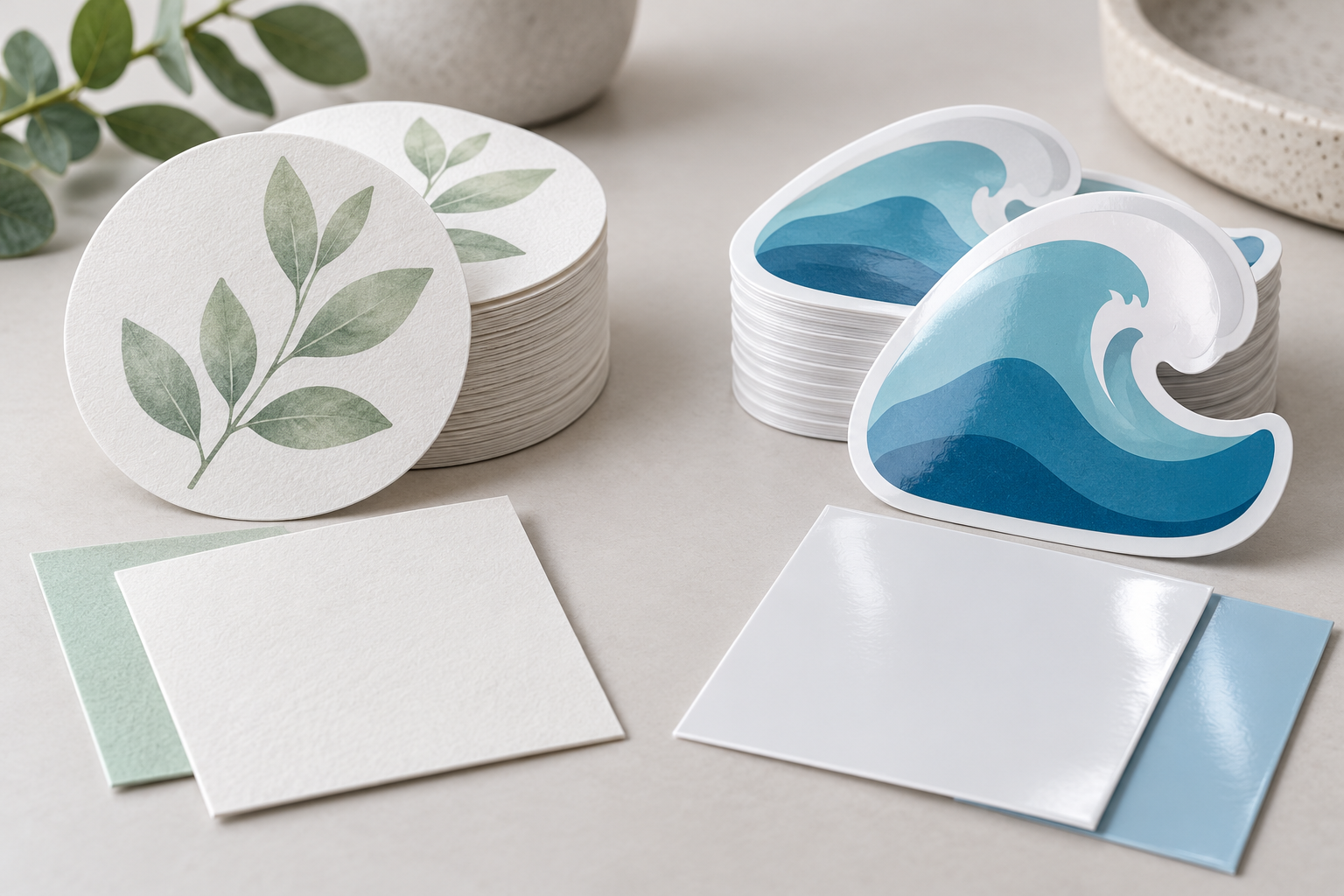
Synthetic paper stickers and vinyl stickers are both film-based alternatives to ordinary paper, but they are not interchangeable. Synthetic paper is a polymer-based material engineered to print and handle like paper, while vinyl is a flexible film commonly chosen for conformability, repeated moisture exposure, and demanding outdoor applications.
Choose synthetic paper when you want a paper-like printed appearance with better resistance to water and tearing. Choose vinyl when flexibility, curved-surface performance, or a tested outdoor construction is the priority. The final result still depends on the adhesive, ink, laminate, surface, and exposure conditions.
Key Takeaways
- Synthetic paper provides a paper-like printing surface with more moisture and tear resistance than conventional paper.
- Vinyl is generally more flexible and conformable on bottles, helmets, cases, and other curved objects.
- Neither material name guarantees waterproof, dishwasher-safe, chemical-resistant, or permanent outdoor performance.
- The adhesive, ink, laminate, application surface, and service conditions must be evaluated as one system.
- Test a production sample on the real surface before placing a large order.
Synthetic Paper vs Vinyl Stickers at a Glance
| Comparison | Synthetic Paper | Vinyl |
|---|---|---|
| Face material | Polymer-based, paper-like substrate | Flexible vinyl film, often PVC when specifically sold as vinyl |
| Appearance | Paper-like, smooth printable surface | Film-like finish in white, clear, gloss, or matte constructions |
| Moisture resistance | Better than ordinary paper; depends on grade and complete construction | Often selected for repeated moisture when product specifications support it |
| Tear resistance | Generally stronger than ordinary paper | Generally flexible and tear-resistant |
| Conformability | Best on smooth, flat, or gently curved surfaces | Usually better on tight curves and contoured objects |
| Typical uses | Refrigerated packaging, bottles, durable promotions, frequently handled labels | Outdoor graphics, bottles, helmets, equipment, cases, curved surfaces |
| Best reason to choose | Paper-like appearance with improved toughness | Flexibility and demanding environmental performance |
These are general tendencies. For a wider comparison that also covers laminated paper, clear material, and asset labels, use our custom sticker material buyer’s guide.
What Is Synthetic Paper?
Synthetic paper is a polymer-based substrate designed to combine film durability with paper-like printing and handling characteristics. It does not contain the same wood-pulp structure as conventional paper, so it is generally less vulnerable to water absorption and tearing.
Grades vary. Some synthetic papers use polypropylene or other polymer systems, and print compatibility depends on the surface treatment, ink, printer, and finishing process. A product described only as “synthetic” should not be assumed to have a specific outdoor lifetime or chemical-resistance rating.
HERMA’s PP Paperprint guidance describes a polypropylene film that combines a coated, paper-like print surface with weather and UV resistance in a specific tested construction. This illustrates why the exact material grade and adhesive matter more than the category name alone.
Our synthetic paper stickers are a practical option when ordinary paper is too vulnerable but the application does not necessarily require a flexible vinyl construction.
What Is a Vinyl Sticker?
A vinyl sticker uses vinyl film as its face material. Vinyl is usually more flexible and conformable than paper-like substrates, which can help a sticker follow bottles, helmets, cases, equipment, and other curved or irregular surfaces.
3M’s Vinyl Durable Label Material FV027805 is described as flexible, conformable, moisture-resistant, and suitable for extended-life outdoor label applications. Those properties apply to that documented construction, including its vinyl face and specified adhesive; they should not be treated as guarantees for every vinyl sticker.
Vinyl can also receive an overlaminate for additional moisture, abrasion, and UV protection. The face film alone is only one part of the performance system.
Which Material Handles Water Better?
Vinyl is usually the stronger starting point for repeated moisture because the face material is a flexible film, but a suitable synthetic paper construction can also perform well around condensation, splashes, and damp handling. Neither option should be called waterproof without product-specific evidence.
Water can affect printed ink, exposed edges, and adhesive even when the face material remains intact. Separate occasional splashes from refrigeration, repeated washing, immersion, rain, and cleaning chemicals before choosing.
- Occasional splashes: synthetic paper or vinyl may work after testing.
- Refrigeration and condensation: confirm the adhesive and test on the actual container.
- Repeated washing or rain: favor a tested film construction with compatible ink and laminate.
- Immersion or chemicals: require documented performance for the complete label system.
Which Material Is Better for Outdoor Use?
Vinyl is generally the better starting point for outdoor use because many outdoor label constructions use flexible vinyl faces, UV-resistant adhesives, and protective laminates. The word “vinyl” alone does not provide an outdoor rating.
Avery Dennison’s outdoor-label guidance explains that weather-resistant performance depends on the label’s role, material, laminate, humidity, ozone, and UV exposure. Its guidance emphasizes that one construction does not fit every outdoor application.
Synthetic paper can be suitable outdoors when the exact substrate, adhesive, ink, and finish have been tested for the expected exposure. For a complete selection process, see our guide to choosing stickers for outdoor use.
Which Material Works Better on Curved Surfaces?
Vinyl usually works better on tight curves and complex contours because it is designed as a flexible film. Synthetic paper is often better on flat or gently curved surfaces where a paper-like appearance matters.
Surface energy and texture can be more important than the face material. Smooth glass and metal are usually easier to label than textured plastic, powder-coated metal, or low-surface-energy polyethylene and polypropylene. Apply a sample, allow the adhesive to build bond, and check for edge lift under realistic use.
Which Material Looks Better?
Neither material is universally better-looking. Synthetic paper is the better choice when the design should resemble a premium paper label, while vinyl is appropriate when a smooth film appearance suits the product or surface.
For a transparent no-label effect, compare clear stickers. Clear material introduces additional artwork decisions, including whether white ink is needed for opacity and contrast.
How to Choose in Five Steps
1. Identify the real surface
Record whether the sticker will be applied to glass, coated paperboard, metal, smooth plastic, textured plastic, or a curved container.
2. Define exposure
List moisture, sunlight, temperature changes, abrasion, chemicals, refrigeration, and cleaning. Distinguish occasional exposure from continuous exposure.
3. Decide how long the sticker must work
A temporary promotion and a multi-year equipment label require different materials and adhesives.
4. Choose the visual result
Select synthetic paper for a paper-like finish, vinyl for flexible film performance, or clear material when the surface should show through.
5. Test a production sample
A digital proof confirms artwork. A physical sample checks adhesion, edge lift, readability, and durability on the actual surface.
Frequently Asked Questions
Is synthetic paper the same as vinyl?
No. Synthetic paper is a broad category of polymer-based materials designed to provide paper-like characteristics. Vinyl is a specific film category valued for flexibility and conformability.
Are synthetic paper stickers waterproof?
Synthetic paper is generally more water-resistant than conventional paper, but the finished sticker is only waterproof if the complete construction, including ink, adhesive, and finish, has been tested for the claimed conditions.
Are all vinyl stickers suitable outdoors?
No. Outdoor performance depends on the vinyl formulation, adhesive, ink, laminate, sunlight, temperature, surface, and expected service life.
Which material is better for bottles?
Synthetic paper can suit dry or refrigerated bottles after testing. Vinyl is usually better for tight curves, repeated moisture, or frequent handling when the specified construction supports those conditions.
Should I order a sample first?
Yes. Test a sample whenever the surface is curved, textured, cold, wet, outdoors, or frequently cleaned.
The Final Decision
Choose synthetic paper when you need a paper-like printable surface with improved resistance to moisture and tearing. Choose vinyl when flexibility, contouring, repeated moisture, or a tested outdoor construction matters more.
Compare the full specification rather than the material name alone. Then shop custom stickers and test the selected construction on the real surface before ordering at scale.
