Clear Stickers for Glass: What You Need to Know Before Ordering

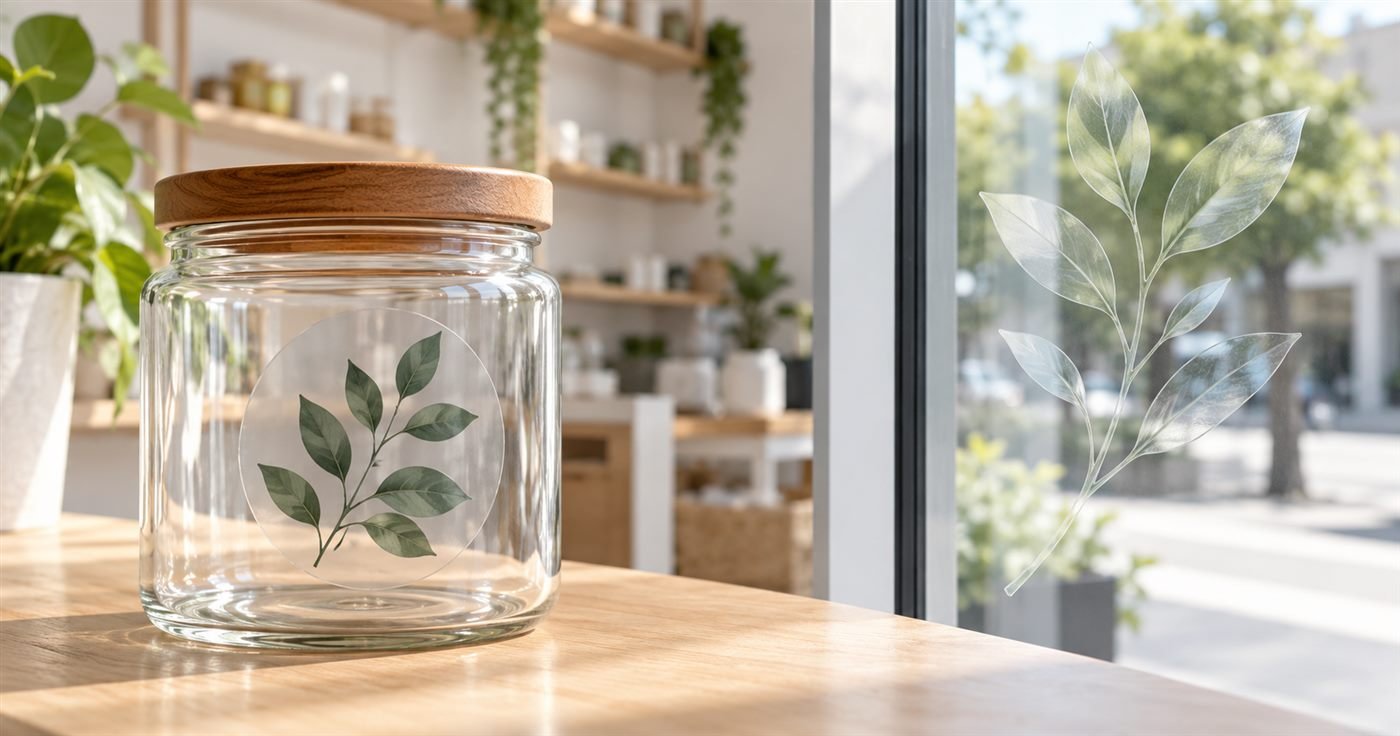
Clear stickers work well on glass when you want the surface or product to remain visible. The best results come from planning the artwork for transparency, choosing the correct viewing direction, and applying the sticker to clean, dry glass.
Glass is visually simple but technically demanding. Reflections, product color, coatings, condensation and cleaner residue can all change the final result. A proof should show more than the cut line: it should also confirm transparent areas, white ink and the intended side of the glass.
Key Takeaways
- Use clear stickers when the glass or product should remain part of the design.
- Add selective white ink when important colors or text need opacity.
- Decide whether the graphic will be viewed from the same side or through the glass before artwork is approved.
- Clean and dry the glass carefully because dust, oil and residue can cause visible bubbles or poor adhesion.
- Test coated, tinted, heated or specialty glass before ordering a large run.
Why Clear Stickers Work on Glass
Unprinted areas of a clear sticker allow the glass to remain visible, creating a minimal look that can resemble printing directly on the surface. This makes clear stickers useful for jars, bottles, windows, display cases and glass doors.
The transparency also exposes every design and application decision. Pale artwork can disappear against the product behind the glass. Dust and fingerprints are easier to see. The same logo may look different on an empty jar, a dark beverage and a brightly lit shop window.
Before selecting the material, compare the visual tradeoffs in our clear stickers vs white vinyl stickers guide.
Choose the Viewing Direction First
Same-side viewing
For a sticker applied to the outside of a bottle or window and viewed from that same side, the artwork usually prints in its normal orientation. The adhesive sits behind the printed face.
Viewed through the glass
For a sticker applied inside a window and read from outside, the artwork may need reverse printing so it appears correctly through the glass. The production order of color and white ink can also change.
Tell the printer:
- Which side of the glass receives the sticker
- Which side the viewer will stand on
- Whether the sticker needs to be read from one side or both
- Whether white ink should support selected colors
Do not mirror the file without confirming the production workflow. The printer may handle reversal and ink order during prepress.
How White Ink Changes Clear Stickers on Glass
Process colors on transparent film are influenced by the glass, lighting and whatever sits behind it. A white underbase can make chosen elements more opaque, while unprinted areas remain clear.
Use selective white ink when:
- Pale brand colors must stay visible
- White text or icons need to print as white
- The bottle contains a dark or changing product
- Small text needs stronger contrast
- The window background varies throughout the day
Skip the white underbase where translucency is intentional. For a detailed comparison, see clear stickers with white ink vs without white ink.
Prepare Glass Before Application
Clean, dry glass is essential. 3M’s building-window guidance recommends cleaning with a lint-free towel and an isopropyl alcohol and water mixture, wiping before the solution evaporates, and ensuring the substrate is completely dry. Avery Dennison likewise emphasizes a clean, dry surface for suitable adhesion.
Use the instructions supplied for the specific sticker material. General precautions include:
- Remove dust and visible dirt before final cleaning.
- Avoid cleaners that leave wax, fragrance, surfactant or anti-static residue unless the material supplier approves them.
- Use clean, lint-free towels and replace them as they become dirty.
- Let the surface dry fully.
- Apply the sticker promptly before new dust settles.
Specialty glass can require extra care. Anti-reflective, scratch-resistant, low-emissivity, tinted, heated or coated glass may not behave like untreated glass. Some professional graphic films exclude particular coatings, heating elements or wipers from recommended applications.
Dry or Wet Application?
The correct method depends on the adhesive system and sticker size. Small stickers are often easier to apply dry. Some large professional window films support a wet method, while other adhesive technologies specifically do not.
Do not assume that spraying water is always safer. ORAFOL states that wet application is appropriate for certain products and clean, smooth, non-porous surfaces, but not for every water-based or air-egress adhesive system. Follow the product-specific instructions rather than a generic social-media tutorial.
For a small dry application:
- Position the sticker before removing the full liner.
- Expose a narrow strip of adhesive.
- Anchor one edge without stretching the film.
- Press from the center outward with overlapping strokes.
- Inspect the perimeter for loose areas.
How to Reduce Bubbles, Dust and Silvering
Visible defects stand out on glass because light passes through the surface. Good preparation prevents more problems than aggressive smoothing after application.
- Work in a clean area away from wind and airborne dust.
- Keep fingertips away from the adhesive.
- Do not stretch the clear film while positioning it.
- Use steady pressure from the center toward the edge.
- Avoid applying to cold, wet or rapidly changing glass.
- Check the supplier’s minimum application temperature.
Some product-specific application guides allow minor visual patterns to change as the adhesive settles, but this cannot be assumed for every clear sticker. Large bubbles, trapped debris and creases should not be treated as normal. Test the technique on a spare sample before installing a large or prominent graphic.
Best Uses for Clear Stickers on Glass
| Application | Why clear material works | Main decision |
|---|---|---|
| Product jars | Keeps the contents visible | Contrast against the product color |
| Beverage bottles | Integrates branding with the bottle | Condensation and white ink |
| Cosmetic packaging | Supports a minimal, premium look | Readability of fine text |
| Shop windows | Preserves light and visibility | Viewing direction and installation method |
| Display cases | Adds branding without an opaque panel | Reflections and cleaning routine |
| Glass doors | Provides branding or identification | Safety markings and sightline visibility |
For packaging, do not let the decorative effect reduce required information or readability. Use an opaque panel or a second label when essential text cannot maintain sufficient contrast on the product background.
When to Test a Sample
Test before a large order when the glass is curved, coated, textured, frequently cleaned or exposed to condensation. Also test when exact brand color or small-text readability matters.
Apply the sample to the real object and review it:
- Empty and filled
- In normal indoor and outdoor light
- From the actual viewing distance
- After the expected cleaning routine
- Against every important product color
The test should answer both visual and practical questions. It does not replace the technical specification, but it can reveal an unsuitable design or surface before production scales up.
Common Questions
Do clear stickers stick to glass?
Yes, clear pressure-sensitive stickers can adhere to suitable smooth glass when the surface is clean, dry and compatible with the adhesive. Coatings, condensation, contamination and very low application temperatures can change the result, so test specialty glass before a large order.
Can clear stickers go on the inside of a window?
Yes, if the material and print setup support inside-glass application. Tell the printer that the graphic will be viewed through the glass so artwork orientation and ink order can be prepared correctly.
Do clear stickers leave residue on glass?
Removal behavior depends on the adhesive, time, heat, sunlight and glass condition. Choose a removable product when clean removal is a requirement and test it on the actual glass.
Will clear sticker colors look the same on every bottle?
No. Transparent ink interacts with the bottle, product and background. Selective white ink can improve consistency in chosen areas.
Are clear stickers suitable for shower glass or refrigerated bottles?
They may be, but moisture, cleaning and temperature changes create additional demands. Confirm the exact construction and test it under realistic conditions. See Are Clear Stickers Waterproof? for a deeper explanation of water exposure.
Plan the Glass, Artwork and Application Together
The best clear sticker for glass is not chosen by transparency alone. Decide the viewing direction, background, white-ink areas, cleaning method and moisture exposure before approving the proof.
Plan Your Clear Stickers for Glass
Choose your size and shape, upload your artwork, and confirm viewing direction and white-ink requirements before production.
You can also browse all custom sticker products, review our custom sticker material guide, or explore the Clear Sticker Guides collection.
