Best Stickers for Outdoor Use: A Practical Material Guide

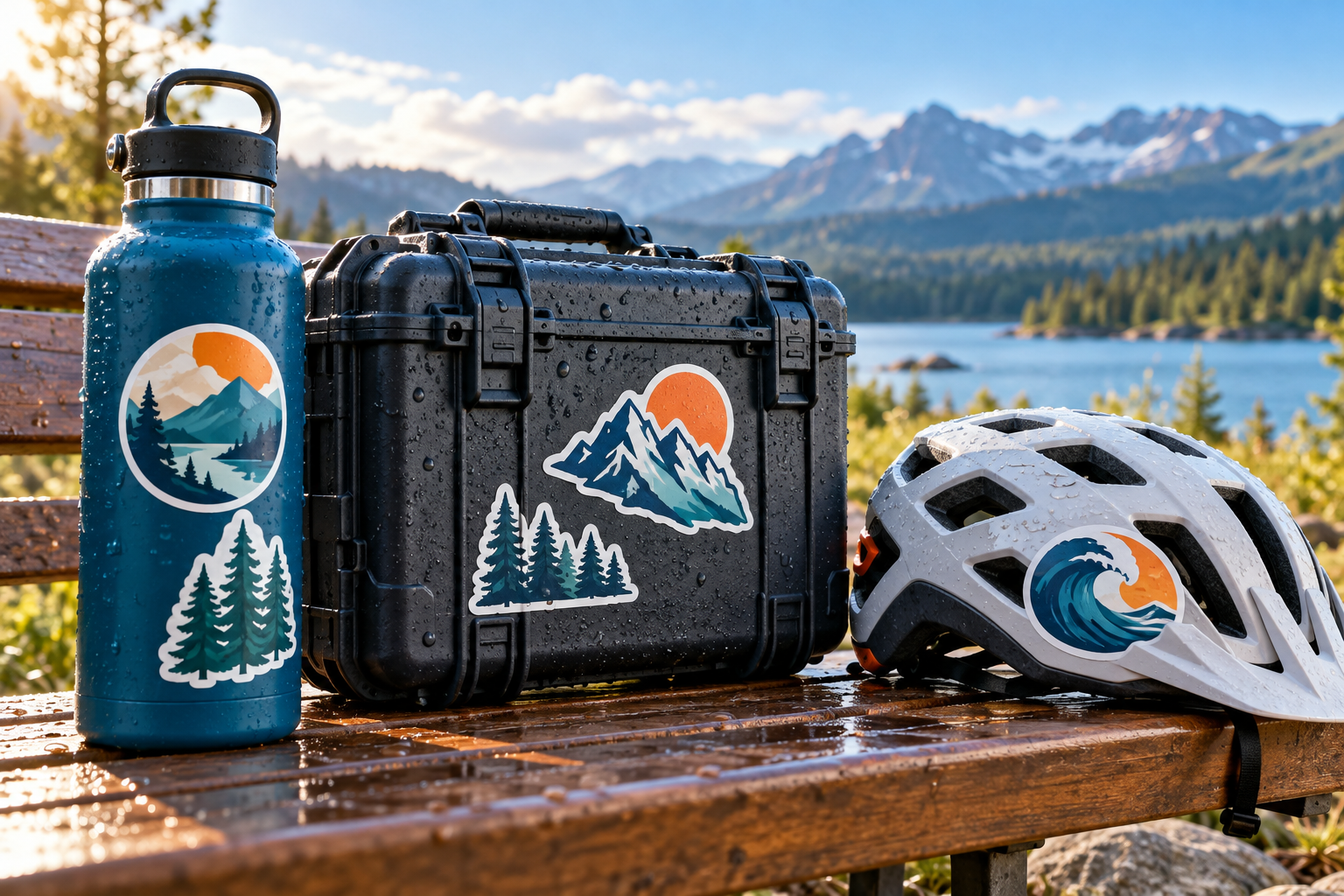
The best stickers for outdoor use are built as a complete weather-resistant system: a suitable film face, compatible ink, outdoor-rated adhesive, and protective laminate when needed. Vinyl is often the strongest starting point for flexible outdoor graphics, while synthetic film and purpose-built durable labels can be better for specific packaging, equipment, and identification jobs.
No material name guarantees outdoor life by itself. Sunlight, rain, humidity, temperature changes, abrasion, chemicals, surface texture, and installation all affect performance. Define those conditions first, then test a production sample on the real surface.
Key Takeaways
- Choose a tested film construction, not a material name alone.
- Vinyl is commonly selected for flexible outdoor graphics and curved surfaces.
- Purpose-built durable labels are the better choice for equipment IDs, barcodes, warnings, and long-term tracking.
- UV protection, ink, adhesive, laminate, and surface preparation are as important as the face material.
- Outdoor claims should match documented specifications and realistic sample testing.
Outdoor Sticker Materials at a Glance
| Material | Best suited for | Main advantage | Check before ordering |
|---|---|---|---|
| Outdoor vinyl | Bottles, helmets, cases, windows, smooth outdoor surfaces | Flexibility and conformability | Outdoor rating, adhesive, ink, laminate, removability |
| Synthetic paper or PP film | Refrigerated packaging, damp handling, durable promotions | Paper-like print surface with improved toughness | Exact substrate grade and tested UV/weather resistance |
| Clear film | Glass, windows, transparent packaging | No-label appearance | White ink, contrast, adhesive clarity, bubbles |
| Durable asset label | Tools, machinery, electronics, serial and barcode identification | Long-term identification performance | Surface, abrasion, chemicals, temperature, certification |
| Laminated paper | Covered outdoor events or short-term limited exposure | Economical protected print | Exposed paper edges and moisture limits |
For a broad explanation of all four main product types, see our custom sticker material guide.
What Makes a Sticker Suitable for Outdoor Use?
An outdoor sticker must resist more than water. The finished construction may encounter UV radiation, rain, humidity, heat, cold, expansion and contraction, abrasion, dirt, cleaners, and repeated handling.
Avery Dennison’s outdoor-equipment guidance explains that there is no one-size-fits-all outdoor test. It recommends evaluating the face, adhesive, print, and protective layer together on production-intended parts under the expected conditions.
A credible outdoor specification should identify the test conditions or intended application. Avoid assuming that “waterproof,” “weatherproof,” or “UV resistant” means unlimited exposure.
Is Vinyl the Best Outdoor Sticker Material?
Vinyl is often the best starting point for general outdoor graphics because it is flexible, conformable, and available with adhesives and laminates designed for demanding environments. It is especially useful on curved objects and frequently handled surfaces.
3M’s Vinyl Durable Label Material FV027805 is an example of a documented construction described as flexible, conformable, moisture-resistant, and suitable for extended-life outdoor labels. The performance belongs to that complete product system, not to every sticker marketed as vinyl.
Compare vinyl with synthetic material in our synthetic paper vs vinyl sticker guide.
When Is Synthetic Paper Suitable Outdoors?
Synthetic paper can work outdoors when the exact polymer substrate, adhesive, ink, and finish are rated for the expected conditions. It is a useful choice when a paper-like printed appearance is desired with more resistance to water and tearing than ordinary paper.
Choose synthetic paper stickers for damp handling, refrigerated packaging, and durable promotions after testing. For continuous rain, strong sunlight, immersion, or aggressive cleaning, request documented specifications rather than relying on the word synthetic.
Can Laminated Paper Be Used Outdoors?
Laminated paper can tolerate limited splashes and short-term protected use, but it is usually not the first choice for repeated outdoor exposure. The laminate protects the printed face while cut paper edges can remain vulnerable to moisture.
Use laminated paper for covered events, temporary signage, and limited-moisture applications only after testing. For a detailed construction comparison, read laminated paper vs vinyl stickers.
When Should You Use Durable Asset Labels?
Purpose-built durable asset labels are the better choice when outdoor information must remain readable for identification, safety, maintenance, or tracking. Typical uses include serial numbers, QR codes, barcodes, warning text, tools, machinery, and electronic equipment.
Asset-label performance depends on the complete system and target surface. A label applied to smooth steel can behave differently on powder-coated metal, textured plastic, or an oily machine housing. Review our durable asset label options for identification-focused applications.
How Do Sunlight and UV Affect Stickers?
UV exposure can fade ink, discolor face materials, weaken some adhesives, and reduce the life of a label. A protective overlaminate can reduce damage, but its rating must match the expected geography, orientation, and service period.
Avery Dennison’s outdoor portfolio describes material and laminate systems designed around UV, weathering, humidity, and ozone. This reinforces the practical rule: ask for a complete outdoor construction, not only a face-material name.
How Do Surface and Installation Affect Outdoor Life?
A strong material can still fail when installed on a dirty, wet, textured, oily, or low-surface-energy surface. Clean and dry the application area using a method compatible with the surface, apply at the specified temperature, and press the full label firmly.
- Glass and smooth metal: usually easier to label after cleaning.
- Textured plastic: may need a more aggressive adhesive and larger contact area.
- Powder-coated metal: requires testing because coatings vary.
- Curved surfaces: benefit from flexible face material and rounded corners.
- Cold application: requires an adhesive designed to wet out at the installation temperature.
How to Choose Outdoor Stickers in Five Steps
1. Describe the surface
Identify its material, texture, curvature, coating, cleanliness, and temperature during application.
2. Define every exposure
List sunlight, rain, humidity, abrasion, cleaning, chemicals, salt, heat, cold, and temperature cycling.
3. Set the service period
Separate a weekend promotion from a multi-year equipment label. Longer service normally requires a more carefully specified system.
4. Match the complete construction
Confirm face material, ink, adhesive, laminate, shape, and edge design together.
5. Test a production sample
Apply the sample to the real surface and expose it to realistic conditions. Monitor adhesion, edge lift, fading, cracking, and readability.
Common Outdoor Sticker Mistakes
Assuming waterproof means weatherproof
Water is only one exposure. Sunlight, heat, cold, abrasion, chemicals, and surface movement can also cause failure.
Choosing the face material but ignoring adhesive
The adhesive controls whether the label bonds to the actual surface through temperature and moisture changes.
Applying labels to unprepared surfaces
Dirt, skin oil, moisture, release agents, and cleaners can reduce adhesion even when the label material is suitable.
Skipping a real-world test
Laboratory properties and category names cannot replace a trial on the production surface in the intended environment.
Frequently Asked Questions
What sticker material lasts longest outdoors?
A purpose-built vinyl, polyester, or other durable film construction often lasts longest, but the exact result depends on the adhesive, ink, laminate, surface, exposure, and documented rating.
Are vinyl stickers automatically waterproof?
No. The vinyl face resists water, but ink, adhesive, laminate, and edges must also tolerate the intended exposure.
Can clear stickers be used outdoors?
Yes, when the clear film, adhesive, ink, and optional white underprint are specified and tested for outdoor use. Check contrast on the actual surface.
Should outdoor stickers have rounded corners?
Rounded corners can reduce snagging and edge lift, especially on frequently handled or curved surfaces, but they do not replace the need for a suitable adhesive.
How should I test an outdoor sticker?
Apply a production sample to the real surface, allow the adhesive to build bond, and expose it to the expected sunlight, moisture, temperature changes, abrasion, and cleaning.
Choose the Construction That Fits the Exposure
The best outdoor sticker is not defined by one material word. Select the face, adhesive, ink, laminate, and shape as a system, match that system to the surface and exposure, then validate it with a realistic sample test.
When you are ready, compare custom sticker options and choose the construction that fits the job.
