How to Choose Custom Labels for Refrigerated Products

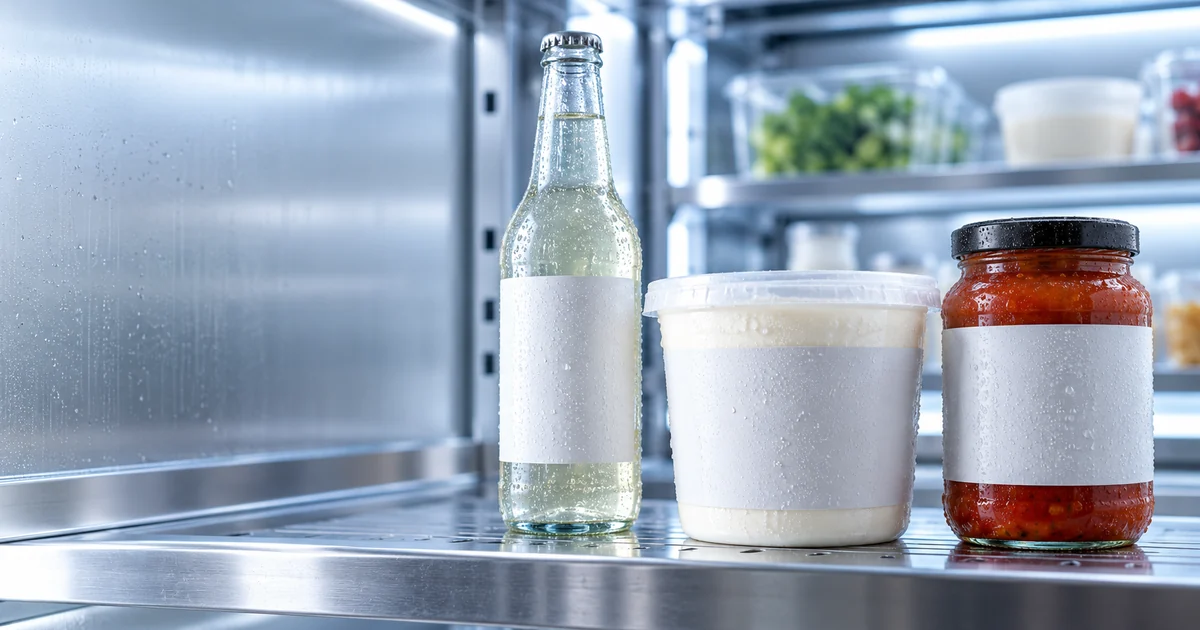
The best label for a refrigerated product is not chosen by temperature alone. Start with the amount of condensation or water exposure, then confirm the container surface, the temperature at application, and how the package will be handled. For bottles, jars, and tubs that regularly become wet, a waterproof synthetic label is a practical starting point—but the finished construction still needs to be tested on the actual package.
If you are choosing custom labels for refrigerated products, start with the packaging and the purchase specification together. YourWaySticker’s waterproof synthetic paper stickers are a current option for bottle labels and refrigerated packaging. This guide helps you compare that option and prepare the details needed before ordering. It does not replace required food-label review or application testing.
Key takeaways: Define the real moisture exposure; specify both application and service temperatures; identify the exact container material and shape; apply only to a clean, dry surface unless a cold-application construction is selected; and test the finished label through the real refrigeration, condensation, handling, and cleaning cycle before a bulk run.
Quick decision table
| Real use condition | What to prioritize | Why |
|---|---|---|
| Dry package, short refrigerated display | Moisture-resistant construction and readable print | Light condensation may be the main risk |
| Bottle or jar that repeatedly “sweats” | Waterproof face material, compatible adhesive, edge-lift testing | Condensation can reach both the printed surface and label edges |
| Package placed in ice or exposed to prolonged water | A construction specifically tested for that wet exposure | Refrigeration and immersion are different demands |
| Label applied to a cold or damp container | Adhesive selected for the actual application temperature and surface | A waterproof face alone cannot correct poor initial contact |
| Curved, textured, or low-surface-energy plastic | Sample testing on the exact container | Shape and surface energy affect contact area and edge lift |
1. How to choose custom waterproof labels for bottles and jars
“Refrigerated” can mean a dry carton in a cooler, a bottle covered in condensation, or a container sitting in melting ice. Those are different label environments.
Avery distinguishes water-resistant labels for splashes, light moisture, and condensation from waterproof labels intended for more regular or prolonged water contact. That distinction is useful when writing your order brief: describe what happens to the package rather than asking only for a “fridge label.” See Avery’s explanation of water-resistant versus waterproof labels.
For containers that repeatedly become wet, custom waterproof synthetic paper stickers are the closest current YourWaySticker product match. The product page supports refrigerated and frozen-product labels and identifies the material as waterproof. If your package will be submerged, exposed to unusual chemicals, or used under a demanding temperature cycle, test the selected construction rather than assuming every waterproof label performs identically.
2. Treat the label as a complete construction
A label is more than its printable face. The face material, print, adhesive, finish, container, and application process work together. A moisture-resistant face can remain intact while an unsuitable adhesive lifts at the edge.
Flexcon’s packaging-material guidance likewise treats face material and adhesive as a matched system, noting that polypropylene face films resist water and moisture while packaging adhesives must be selected for container type and exposure. See the Flexcon packaging product brochure.
Before ordering, document:
- container material, such as glass, PET, HDPE, coated paperboard, or metal;
- whether the surface is smooth, curved, textured, oily, or treated;
- whether labels are applied before chilling or to an already cold container;
- expected condensation, splashing, cleaning, abrasion, or ice exposure;
- minimum label size and the smallest required text or barcode.
The YourWaySticker synthetic-paper product page also recommends sampling curved, textured, and low-surface-energy materials. That is especially important when one design will be used across several package types.
3. Separate application temperature from service temperature
The temperature when a label is applied is not the same as the temperature it experiences later. Pressure-sensitive adhesive needs intimate contact with a clean surface to begin forming a bond. Condensed moisture can block that contact.
In its technical guidance for a pressure-sensitive adhesive, 3M says surfaces should be dry and free of condensed moisture and explains that bond strength increases as the adhesive wets out over time. The exact temperatures in that document apply to that specific 3M product, not automatically to every label, but the application principle is broadly useful: specify both the labeling conditions and the later storage conditions. Review the 3M technical data sheet for the original context.
When possible, label a clean, dry container under the conditions recommended for the selected adhesive, then allow the bond to develop before refrigeration or heavy handling. If your production line labels pre-chilled packages, say so before ordering; do not assume a standard adhesive is suitable.
4. Prepare the package surface consistently
Surface preparation is a production control, not a last-minute fix. Dust, grease, cleaning residue, and condensation can create weak areas under the label.
Use a repeatable process:
- Confirm that the container and cleaning method are compatible.
- Remove dust, grease, fingerprints, and residue.
- Let the surface dry completely.
- Apply the label smoothly with firm, even pressure.
- Hold labeled samples through the real chill, handling, and moisture cycle.
Test samples at label edges and on the tightest curve. Those are common places to spot an application mismatch early.
5. Design for a wet, handled package
Refrigerated packaging is viewed through condensation, handled with wet fingers, and often displayed under glare. Artwork should remain readable under those conditions.
Use adequate contrast and avoid making required information unnecessarily small. Keep critical text and logos inside the safe area, extend backgrounds through the bleed, and leave enough quiet space around any barcode. Measure the available label panel and the container circumference so wrap labels do not overlap unintentionally.
If you are comparing film-like waterproof options, read synthetic paper vs. vinyl stickers for a material-level comparison. For packages that must remain visibly transparent, clear stickers for glass explains how surface visibility and white ink affect the result.
For a broader comparison before choosing any construction, use the custom sticker material buyer’s guide as the pillar overview.
6. Run a realistic sample test before a bulk order
A useful test reproduces the actual workflow, not just a few minutes in a household refrigerator. Apply samples with the intended production method, then expose them to the planned chill time, condensation cycles, handling, wiping, and—in relevant cases—ice or cleaning agents.
Check for:
- edge lift, sliding, bubbles, or tunneling;
- wrinkling, whitening, tearing, or print damage;
- readability when the package is wet;
- barcode scanning, if a barcode is part of the artwork;
- label movement or overlap on tight curves;
- changes after the package returns to room temperature.
Record the package material, application temperature, dwell time before chilling, and test result. That makes the next order easier to specify and prevents a successful sample from becoming an undocumented guess.
What to confirm before ordering custom bottle labels
When comparing custom printed bottle labels, use the same specification for each option: finished size, quantity, artwork, container surface, and wet-use conditions. A label intended for a dry display is not an equivalent substitute for packaging that repeatedly develops condensation. Confirm the quoted total, available quantities, delivery terms, and fit for your application before placing the order; none of those conditions should be assumed from the word "waterproof."
Provide the container material, a photo or sample, label dimensions, quantity, artwork, refrigeration range, application temperature, and a plain-language description of moisture exposure. Mention whether the package is labeled cold, stored in ice, wiped with cleaners, or moved repeatedly between cold and room temperature.
Ready to evaluate a waterproof option? Review custom waterproof synthetic paper stickers, submit your real use conditions with the order inquiry, and test the finished label on your container before committing to a large run.
Frequently asked questions
Are waterproof labels automatically suitable for every refrigerator or freezer?
No. Waterproof describes an important material property, but adhesive choice, application temperature, container surface, condensation, handling, and temperature cycling also affect performance. Confirm the full construction and test it in the real application.
Should labels be applied before products are chilled?
Applying to a clean, dry container before chilling is often the simpler condition, because condensation can interfere with initial adhesive contact. If your process requires cold application, disclose the actual surface and temperature so an appropriate adhesive can be considered.
Are paper stickers a good choice for refrigerated bottles?
For dry, short-term refrigerated use, a suitable paper construction may be considered. For bottles that regularly develop condensation or encounter water, a waterproof synthetic option is the safer starting point. Test the actual package rather than relying on the face material name alone.
What is the most important sample-test condition?
Use the exact container and reproduce the actual labeling, refrigeration, condensation, handling, and cleaning cycle. A test on a different plastic, at room temperature, or without moisture may not predict production performance.
Editorial basis: prepared by the YourWay Sticker Editorial Team from the current YourWaySticker product specification and the linked Avery, 3M, and Flexcon first-party guidance. Product fit must still be confirmed under the buyer’s real conditions.
